America's "Safest Long Term Investment" Is Gold - Gallup
Americans feel “gold is the safest long term investment” today, a
Gallup survey has found. Gold was favoured over four other types of
investments perceived as the best long term choice for American
investors today. 28% of the American public choose gold as their
favoured investment of choice today. Real estate followed in second
place, with 20% seeing it as the best long term investment. Paper
assets were less popular with savings accounts and certificates of
deposits (CDs) tied with stocks and mutual funds at 19%. Bonds came last at 8%.
This suggests that the American public may not be as uninformed when it
comes to investing as is often suggested. According to Gallup,
"investing in gold has gained in popularity in recent years as low
interest rates have made traditional savings instruments less
attractive, and instability in the stock and real estate markets has
undermined the mass appeal of those options." "Meanwhile, the rising
trajectory of the price of gold over the past several years apparently
offers more of the returns and stability investors seek." While some
may find the Gallup poll findings worrisome from a contrarian
perspective, it is not.
Europe's Scariest Chart Just Got Scarier-er
 We were the first to note the dire state of youth unemployment in Europe here, and reiterated here,
as this terrible social situation just goes from bad to worse this
month. Whether youth unemployment is a proxy for sales of PlayStations
or for the much more critical likelihood of widespread social unrest and
eventually the dissolution of Europe's political compact is unclear
but one thing is for sure - Europe's leaders will be watching this
chart and quaking as nation after nation breaks to all-time high levels
of joblessness for the critical tinder-box of Under-25 year-olds. The Euro-zone youth unemployment rate is back over 22% for the first time since September 1994. With Spain and Greece over 50% (and rising) and Italy now joining Ireland over 35% at the same time as Germany's youth unemployment falls below 8% for the first time since May 1993 - one can only surmise the rising tensions between the haves and the have-nots (even as Germany's PMI disappoints).
We were the first to note the dire state of youth unemployment in Europe here, and reiterated here,
as this terrible social situation just goes from bad to worse this
month. Whether youth unemployment is a proxy for sales of PlayStations
or for the much more critical likelihood of widespread social unrest and
eventually the dissolution of Europe's political compact is unclear
but one thing is for sure - Europe's leaders will be watching this
chart and quaking as nation after nation breaks to all-time high levels
of joblessness for the critical tinder-box of Under-25 year-olds. The Euro-zone youth unemployment rate is back over 22% for the first time since September 1994. With Spain and Greece over 50% (and rising) and Italy now joining Ireland over 35% at the same time as Germany's youth unemployment falls below 8% for the first time since May 1993 - one can only surmise the rising tensions between the haves and the have-nots (even as Germany's PMI disappoints).ADP Misses Big, Prints Lowest Increase Since September; Manufacturing Jobs Post Shocking Decline
 Those
hoping Goldman's NFP forecast of 125,000, well below consensus, is
wrong, may have to reassess their thesis following the just released
ADP number which came as a big disappointment to consensus of 170,000,
instead printing at only +119,000, to 110,590. (The previous improvement
was also downward revised from +209K to +201K). This was the lowest sequential change since September 2011,
and confirms once again, the declining trends last seen in... 2011. It
was also the biggest miss in 11 months. Luckily, as the scatterplot
below shows, ADP is completely meaningless when predicting NFP so our
gut reaction would be to expect a beat in NFP based on this print
considering the whole Schrodinger economy and what not (see China).
However, on an apples to apples basis, one thing is certain: record warm
winter payback is a bitch. And finally, that whole Obama export
renaissance is not doing all too hot: goods producing sector: -4,000 in April, while manufacturing jobs declined by -5,000. But, but, the soaring ISM..... oh forget it.
Those
hoping Goldman's NFP forecast of 125,000, well below consensus, is
wrong, may have to reassess their thesis following the just released
ADP number which came as a big disappointment to consensus of 170,000,
instead printing at only +119,000, to 110,590. (The previous improvement
was also downward revised from +209K to +201K). This was the lowest sequential change since September 2011,
and confirms once again, the declining trends last seen in... 2011. It
was also the biggest miss in 11 months. Luckily, as the scatterplot
below shows, ADP is completely meaningless when predicting NFP so our
gut reaction would be to expect a beat in NFP based on this print
considering the whole Schrodinger economy and what not (see China).
However, on an apples to apples basis, one thing is certain: record warm
winter payback is a bitch. And finally, that whole Obama export
renaissance is not doing all too hot: goods producing sector: -4,000 in April, while manufacturing jobs declined by -5,000. But, but, the soaring ISM..... oh forget it.And So The World Burns: Global April PMI Summary

No need for much commentary here, suffice to say that those who thought Italy's massive drop in PMI from 47.9 to 43.9 in April was bad, apparently have not seen Hungary, Australia, Norway or Switzerland. The good news? Turkey is doing well to quite well... which likely explains why they are trying to confiscate the people's gold.
Today’s Items:
Export are slowing to Europe, Asia, and
the U.S. Add to this, the Dallas FEed and Chicago PMI weak numbers and
the air is going out the world’s economic balloon. So, hang on because
the ride is going to get more bumpy.
With the huge shadow inventory, is it any
wonder that housing prices are dropping like a rock. In fact, after
adjusting for inflation, housing prices have actually returned to 1986
levels. That’s because the natural rate of price appreciation for houses
is zero after inflation.
Sooner or later there will be tremendous
price inflation with the euro and the world’s perceived reserved
currency… the U.S. Dollar. The idea, by the Central Banks, may be to
create an “order out of chaos” strategy where people will have to use
IMF bogus currency. The only problem with that insane idea is the fact
that the BRICS are already using gold as payment for oil.
Missouri is trying to follow Utah’s
example for gold and silver to be used as money. This plan is similar
to a law passed in Utah, which allows citizens to use a bank card
“backed” by physical gold and silver. Another reason to keep stacking.
Here are a few…
1. Why are federal government agencies stockpiling massive amounts of food and ammunition?
2. Why is Wall Street laying off thousands of workers if the economy is getting better?
3. Why is the Milwaukee Red Cross being told to prepare for an evacuation of Chicago?
4. Why is cesium-137 from the Fukushima nuclear disaster still showing up in milk in Vermont?
Inquiring minds want to know…
1. Why are federal government agencies stockpiling massive amounts of food and ammunition?
2. Why is Wall Street laying off thousands of workers if the economy is getting better?
3. Why is the Milwaukee Red Cross being told to prepare for an evacuation of Chicago?
4. Why is cesium-137 from the Fukushima nuclear disaster still showing up in milk in Vermont?
Inquiring minds want to know…
As we approach that Reichstag
moment, where the U.S. Constitution is totally thrown out the window,
we get to enjoy more scare tactics from the FBI, and other government
agencies, as 5 men were arrested, and ordered jailed, for planning to
blow up a bridge near Cleveland. Legitimate or propaganda… You decide.
Although unlikely an accident, it turns out that Obama’s re-election slogan “Forward” has had a long association with European Marxism during the 19th and 20th century. Seriously, is any one surprised?
Well, Al Armendariz, the EPA regional
boss who wanted to crucify oil companies, has resigned. This fool’s
resignation is a good start; however, how about an investigation on all
of his cases where he may have acted inappropriately and fine him
accordingly?
Please donate...
Thank You
We Are Not Powerless: Resisting Financial Feudalism
The pathway of dissent is to resist financial feudalism and its enforcer, the expansive Central State. Here are twelve paths of resistance any adult can legally pursue in the course of their daily lives:- Support the decentralized, non-market economy
- Stop participating in financialization
- Redefine self-interest to exclude debt-servitude and dependence on consumerism and the Central State
- Act on your awareness that the nature of prosperity and financial security is changing
- Stop supporting distant concentrations of capital that subvert democracy by using their gargantuan profits to buy the machinery of State governance and regulation
- Stop supporting the debt-and-leverage based financial aristocracy
- Transfer your assets out of Wall Street and into local enterprises or assets that do not enrich and empower Wall Street.
- Refuse to participate in consumerist status identifiers and the social defeat they create
- Vote in every election with an eye on rewarding honesty and truth and punishing empty promises
- Stop supporting inflationary policies such as “money creation” by the Federal Reserve and Federal deficit borrowing
- Become healthy, active and fit
- Embrace self-directed coherent plans and construct a resilient, diverse ecology of identity and meaning
The Federal Reserve Has Zero Credibility
Admin at Jim Rogers Blog - 25 minutes ago
Mr. Bernanke has zero credibility as far as I am concerned. The Federal
Reserve has zero credibility. -* in a recent video interview with the WSJ *
*Jim Rogers is an author, financial commentator and successful
international investor. He has been frequently featured in Time, The New
York Times, Barron’s, Forbes, Fortune, The Wall Street Journal, The
Financial Times and is a regular guest on Bloomberg and CNBC.*
I Think That The Markets For The Next 1-2 Months Will Be Going Lower
Admin at Marc Faber Blog - 32 minutes ago
If you would build an advance/decline line of all stock markets in the
world, it would be in a downtrend. And I think that the markets for the
next one-two months will be going lower. - *in ET*
*
*
*Related, iShares MSCI Emerging Markets Index ETF (EEM), iShares Russell
2000 Index ETF (IWM) *
*
*
*Marc Faber is an international investor known for his uncanny predictions
of the stock market and futures markets around the world.*
India: Fiscal Deficit And Government Debt
Admin at Marc Faber Blog - 37 minutes ago
The situation in India is a situation where the fiscal deficit is
essentially very high and obviously the government debt is increasing. The
rating agencies do their ratings. I don’t pay much attention to that. But
obviously although they have a time lag, they probably are in the right
direction in terms of downgrading India. - *in Economic Times*
Related, WisdomTree India Earnings Fund ETF (EPI)
*Marc Faber is an international investor known for his uncanny predictions
of the stock market and futures markets around the world.*
Wall Street climbs as economy fears ease
Eric De Groot at Eric De Groot - 2 hours ago
Small and large cap stocks total return indices already set new all-time
highs in February and March, respectively. Chart 1: Small Cap Stocks Total
Return Index (SCSTRI) and Z Scores of Secular Trends Chart 2: Large Cap
Stocks Total Return Index (LCSTRI) and Z Scores of Secular Trends Headline:
Wall Street climbs as economy fears ease NEW YORK (Reuters) - Stocks
rallied on...
[[ This is a content summary only. Visit my website for full links, other
content, and more! ]]
I Like To Buy Neglected Assets
Admin at Marc Faber Blog - 11 hours ago
*I like to buy assets that are neglected. In Arizona you can buy a
beautiful house for 150,000 USD. This is undervaluation. - in Bloomberg TV*
*
*
*Marc Faber is an international investor known for his uncanny predictions
of the stock market and futures markets around the world.*
The First Panacea For A Mismanaged Nation Is Inflation Of The Currency
Admin at Marc Faber Blog - 11 hours ago
“The first panacea for a mismanaged nation is inflation of the currency;
the second is war. Both bring a temporary prosperity; both bring permanent
ruin.” - *Dr. Faber quoting Ernest Hemingway in the CFA Institute Middle
East Investment Conference*
*Marc Faber is an international investor known for his uncanny predictions
of the stock market and futures markets around the world.*
Western Democracies: Are People Really Free?
Admin at Marc Faber Blog - 11 hours ago
We have democracies in the Western World but are people really free? - *in
a recent RT video interview*
*Marc Faber is an international investor known for his uncanny predictions
of the stock market and futures markets around the world.*
The Next Slowdown Is Going To Be Even Worse
Admin at Jim Rogers Blog - 11 hours ago
I’m not the only person who knows this is all a scam built on sand; we have
problems and they’re going to be worse. In 2002, America had a slowdown. In
2008, the slowdown was worse, because the debt was so much higher. Well,
the next slowdown is going to be even worse because the debt is going to be
that much higher. *Related, SPDR S&P 500 Index ETF (SPY)* *Jim Rogers is an
author, financial commentator and successful international investor. He has
been frequently featured in Time, The New York Times, Barron’s, Forbes,
Fortune, The Wall Street Journal, The Financial Times and is a re... more »
My Favorite Saying
Admin at Jim Rogers Blog - 11 hours ago
Try, try again. Persevere. - *favourite saying* *Jim Rogers is an author,
financial commentator and successful international investor. He has been
frequently featured in Time, The New York Times, Barron’s, Forbes, Fortune,
The Wall Street Journal, The Financial Times and is a regular guest on
Bloomberg and CNBC.*
I Shorted Treasury Bonds Again
Admin at Jim Rogers Blog - 11 hours ago
I shorted Treasury bonds again a little while ago, and my timing has never been very good in that market. I’m down a little bit, not much. - *in a recent video interview* *Related, ProShares UltraShort 20+ Year Treasuries ETF (TBT)* *Jim Rogers is an author, financial commentator and successful international investor. He has been frequently featured in Time, The New York Times, Barron’s, Forbes, Fortune, The Wall Street Journal, The Financial Times and is a regular guest on Bloomberg and CNBC.*
US Factory Orders Post Biggest Decline Since March 2009
 That
March factory orders declined 1.5% was not very surprising: the market
was expecting a decline of 1.6%. However, this is not good news as the
prior February increase of 1.3% was revised lower to 1.1%, netting out
as a negative two month change. Where this number was troubling is
that this 2.6% swing brought the index to its biggest decline since
March 2009 when the pumping of trillions started.
That
March factory orders declined 1.5% was not very surprising: the market
was expecting a decline of 1.6%. However, this is not good news as the
prior February increase of 1.3% was revised lower to 1.1%, netting out
as a negative two month change. Where this number was troubling is
that this 2.6% swing brought the index to its biggest decline since
March 2009 when the pumping of trillions started.TBAC Unanimously Recommends Start Of Floating Rate Treasury Issuance
As we suggested yesterday, the Treasury Borrowing Advisory Committee (basically Goldman Sachs and JP Morgan, and the rest of the buy and sell side) did indeed come out with a unanimous decision, having decided to recommend FRNs. This simply means that Wall Street is either desperate to telegraph a surge in short-term rates, or, even worse, if actually anticipating a surge in short-term rates and is doing all it can to hedge before it happens. Nonetheless, "system limitations would prevent any possible issuance of FRNs until 2013" while those wondering what the reference rate will be will have no answer for a while: "In discussing the best index, the member recommendations were divided, with 4 members voting for Treasury bills, 3 members voting for a general collateral rate, and 6 members voting for the federal funds effective rate." Finally, anyone wondering why the market acted odd yesterday, i.e., experienced a freak sell off in the afternoon, the reason is that Brian Sack was also present at the TBAC meeting, and away from his trusty BBG terminal.The Divergence Becomes Distinct
 We
have said, for months now, that Europe and the United States were
heading in two different directions. That became quite clear today as
the manufacturing numbers for Europe were dismal while unemployment for
the entire Eurozone reached 10.9% which is up 9.1% from last year. The
entire Continent is in a recession, with the exception of Germany, and
we think their next release, in mid May, will show that they have
joined the rest of their brethern. Austerity has its costs and
two of them are increased unemployment and a decline in demand for
goods and services which is then exacerbated by the drop in the number
of people that are working. In the months ahead, for both
political and economic reasons, we will see a flight back to American
assets as the picture in Europe becomes both clearer and obviously
worse. All of this, however, will affect American corporations and our
banks so that expectations should be lowered in coming quarters for American earnings and profits.
As “no man is an island,” no region of the world will be exempt from
the European recession just as Europe was not exempt from our financial
crisis.
We
have said, for months now, that Europe and the United States were
heading in two different directions. That became quite clear today as
the manufacturing numbers for Europe were dismal while unemployment for
the entire Eurozone reached 10.9% which is up 9.1% from last year. The
entire Continent is in a recession, with the exception of Germany, and
we think their next release, in mid May, will show that they have
joined the rest of their brethern. Austerity has its costs and
two of them are increased unemployment and a decline in demand for
goods and services which is then exacerbated by the drop in the number
of people that are working. In the months ahead, for both
political and economic reasons, we will see a flight back to American
assets as the picture in Europe becomes both clearer and obviously
worse. All of this, however, will affect American corporations and our
banks so that expectations should be lowered in coming quarters for American earnings and profits.
As “no man is an island,” no region of the world will be exempt from
the European recession just as Europe was not exempt from our financial
crisis.Daily US Opening News And Market Re-Cap: May 2
In the early hours of the European session, continental markets opened higher, reacting to yesterday’s positive performance in the US. Sentiment quickly turned as continental Europe released its respective Manufacturing PMI figures, with even the core European nations recording declines in the sector and lower-than-expected readings. Despite the poor data, some major cash markets are clinging on to positive territory, as the CAC and DAX indices both trade higher. The Spanish and Italian markets, however, tell a different story. With both their respective PMIs recording significant declines, both now trade lower by around 2% apiece. Against the flow of bad Eurozone news, the UK has released an expectation-beating Construction PMI figure, going somewhat against last week’s breakdown of the official GDP statistics. Markit research cites strength in commercial work and new orders as the main driver for the growth. The downbeat data from Europe has taken its toll on EUR/USD, currently trading lower by over 90 pips, but the pair has come off the lows in recent trade. GBP/USD has mirrored the moves in the EUR and trades lower by over 40 pips, however some support has been gained from the strong Construction PMI.Draghi Straits - Money For Nothing
The question for investors is how likely Draghi unleashes some new money and gives the market another brief relief rally? I’m not sure he is able to do anything meaningful and right now I believe the market will fade over the course of the day as realization sets in that not much can be done. I’m not quite ready to put this trade on, but am looking closely at going long Spanish stocks versus short German stocks. The belief that Germany will be fine while Spain is a disaster seems too common and priced in. I’m not quite there on that trade, but it is only that am looking at very closely.Overnight Sentiment: Europe Is Open

For those who follow the overnight session and know very well that the only factor there is whether Europe is open or closed (like yesterday), we have three words: Europe was open. As BofA summarizes: "Yesterday's stronger than expected ISM manufacturing sparked a solid rally in the S&P 500. Around mid-day the index was up about 1.2%; however, the markets slowly faded throughout the rest of the day ending up 0.6%. Our equity strategy team things that the S&P is roughly at its fair value given the macroeconomic backdrop and the continued troubles in the Euro area." It is hardly rocket science that Europe will continue to drag on the world. The only question is how long before this nexus of global trade drags everyone else down, because as hard as they try the US and the BRICs simply can not pull away from the tractor beam of the European black hole.
Frontrunning: May 2
- European Unemployment Rate Rises to Highest in Almost 15 Years (Bloomberg)
- Chinese Activist Leaves U.S. Embassy (WSJ)
- China April bank loans slide 30 pct from March-paper (Reuters)
- Moody's warns against lack of tax hike in Japan (Reuters)
- RIM CEO Bets on BlackBerry Without Keyboard to Challenge Apple (Bloomberg)
- European visits focus on boosting trade (China Daily)
- Martin Wolf- After the bonfire of the verities (FT)
- German Jobless Unexpectedly Up in April as Crisis Flared (Bloomberg)
- Romney Refuses to See China Progress on Yuan (Bloomberg)
- Bolivia Following Argentine Takeover Deepens Regional Divide (Bloomberg)
- Plosser Says Fed Must Guard Against Long-Term Inflation (Bloomberg)
Eurosis Is Back With A Bang: PMIs Collapse, Unemployment Surges To Record

Yesterday we poked fun of Goldman for suggesting that the reason for the late-day sell off was "Prudent profit-taking as folks remember Europe isn’t closed tomorrow." Turns out Goldman could not have been more right: around 4 am Eastern this morning Europe reported a series of economic updates which showed that the European economy continues to be nothing but a slow motion trainwreck and is getting far worse. Starting with final April Eurozone Manufacturing PMI which printed at 45.9 vs an initial print of 46.0, a 9 month low with a core breakdown is as follows: Italian manufacturing PMI 43.8 at a 6 month low, est 47.1 (prior 47.9), German manufacturing PMI at a 33 month low 46.2 vs initial 46.3 (prior 48.4), France manufacturing PMI 46.9 vs initial 47.3 (prior 46.7), which also followed Italy by recording sharpest drop in manufacturing new orders in 3 yrs in April, and so on as can be seen in the chart below. As every sellsider who has opined so far this morning, these numbers are all "hugely disappointing."
Sixth Month-In-A-Row Of Chinese Manufacturing Contraction As Jobs Fall Fastest In 3 Years
 Confirming what we already knew last night,
HSBC just announced their final manufacturing PMI (revised slightly
higher from the flash PMI) but confirming - via their data - that China is now in its sixth month of manufacturing contraction.
Of course this is entirely irrelevant as last night China itself
pointed out via its manufacturing PMI data that all was well and in fact
the Chinese economy is expanding at its fastest in 14 months. The
April HSBC print was modestly higher than the March print (so green
shooters will be happy with their second derivatives) but the divergence between HSBC and China on this data point remains vast and digging into the sub-indices we see manufacturing output decreased for the second month in a row, new business fell marginally, but employment was down at the fastest rate in over three years as the need to streamline workforce numbers was cited by many as a response to lower output requirements.
Confirming what we already knew last night,
HSBC just announced their final manufacturing PMI (revised slightly
higher from the flash PMI) but confirming - via their data - that China is now in its sixth month of manufacturing contraction.
Of course this is entirely irrelevant as last night China itself
pointed out via its manufacturing PMI data that all was well and in fact
the Chinese economy is expanding at its fastest in 14 months. The
April HSBC print was modestly higher than the March print (so green
shooters will be happy with their second derivatives) but the divergence between HSBC and China on this data point remains vast and digging into the sub-indices we see manufacturing output decreased for the second month in a row, new business fell marginally, but employment was down at the fastest rate in over three years as the need to streamline workforce numbers was cited by many as a response to lower output requirements.Of Generational Cycles, Kondratieff Waves, And Credit Expansion
 While cycle or wave analysis is often dismissed for its tough-to-utilize-going-forward nature, Charles Hugh-Smith and Gordon T. Long
expertly and thoroughly discuss a myriad of critical processes that the
world (and endogenously or exogenously human beings and markets)
transitions through in this clip. The intersection of Hugh-Smith's four critical trends (generational (or Fourth Turning), wage-inflation/stagnation, credit expansion/contraction, and energy extraction/depletion)
is where we find ourselves as he notes directly that the generational
cycle (of four twenty-year cycles culminating in massive geopolitical
upheaval) is due to climax in the not-too-distant future.
This presentation, which builds on the idea of behavioral changes and
the generational knowledge transfer that for instance is now missing
from the last great depression (do we need to learn the lesson of
"excess credit is bad" once again?), is akin to 'everything you wanted to know about long-waves in social, political, and economic cycles but were afraid to ask'.
While cycle or wave analysis is often dismissed for its tough-to-utilize-going-forward nature, Charles Hugh-Smith and Gordon T. Long
expertly and thoroughly discuss a myriad of critical processes that the
world (and endogenously or exogenously human beings and markets)
transitions through in this clip. The intersection of Hugh-Smith's four critical trends (generational (or Fourth Turning), wage-inflation/stagnation, credit expansion/contraction, and energy extraction/depletion)
is where we find ourselves as he notes directly that the generational
cycle (of four twenty-year cycles culminating in massive geopolitical
upheaval) is due to climax in the not-too-distant future.
This presentation, which builds on the idea of behavioral changes and
the generational knowledge transfer that for instance is now missing
from the last great depression (do we need to learn the lesson of
"excess credit is bad" once again?), is akin to 'everything you wanted to know about long-waves in social, political, and economic cycles but were afraid to ask'.Is Central Planning About To Cost The Jobs Of Your Favorite CNBC Anchors?

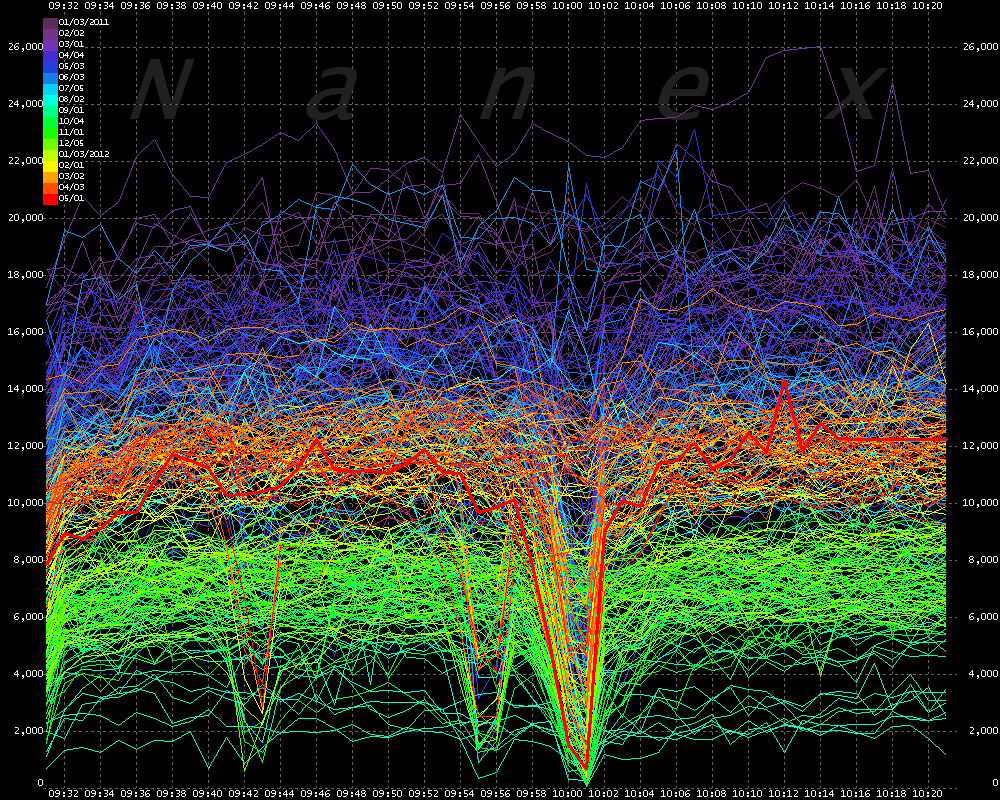
Something funny happened when last August CNBC hired access journalist extraordinaire Andrew Sorkin to spiff up its 6-9 am block also known as Squawk Box: nothing. At least, nothing from a secular viewership basis, because while the block saw a brief pick up in viewership driven by the concurrent (first of many) US debt ceiling crisis and rating downgrade, it has been a downhill slide ever since. In fact, as the chart below shows, the Nielsen rating for the show's core 25-54 demo just slid to multi-year lows. And as NY Daily News, the seemingly ceaseless slide has forced CNBC to start panicking: "CNBC insiders tell us executives at the cable business channel are “freaking out” because viewership levels are down essentially across-the-board, particularly with its marquee shows, “Squawk Box” and “Closing Bell." “Their biggest attractions have become their biggest losers,” says one TV industry insider familiar with the cable channel’s numbers. According to Nielsen ratings obtained by Gatecrasher, from April 2011 to April 2012, “Squawk Box” is down 16 percent in total viewers and 29 percent in the important 25-54 demographic bracket that advertisers buy." Yet is it really fair to blame the slide of the morning block's show on just one man?


 In one of the most complete documentaries undertaken on the financial crisis,
  Equity
indices managed to close green on a generally lower-than-average
volume day but while the morning was dominated by a 20pt rip post-ISM's
4.5-sigma surprise, the post-Europe-close afternoon session saw us give back over 60% of those gains on rising volume and average trade-size.
As the day-session closed, ES (the S&P 500 e-mini futures) was
right around yesterday's highs and today's VWAP in a relatively balanced
manner but after-hours was leaking lower still. AAPL also had a big
rotation day as it opened red, surged into the middle of the day then
gave it all back to close within a few pennies of its 50DMA (and in fact
is trading below it in after-hours trading). Stocks pushed well ahead
of credit markets as they rallied and HYG was far less impressed. Sure
enough by the close, equities had limped back in line with
credit's reality but in the meantime, HYG was back down at last
Wednesday's levels. The ISM caused the USD to pop, stocks to
pop more, oil to pop about the same and gold/silver/Treasuries to drop.
The post Europe-close action saw stocks give back most of those gains,
the USD leak back lower (as CAD strengthened), Oil maintained it bid over $106 (month highs) and Gold/Silver pulled back up nicely. Treasuries remained under pressure
though with only a very late-day dip lower in yields to show for the
dips in stocks. As expected, Energy and Financials outperformed
close-to-close on a rally-day but also retraced the most in the
afternoon as Discretionary and Materials also joined the high-beta fray.
The strength in oil and weakness in TSYs was enough to juice
risk-assets in general and provided some support for the rally but stocks remain rich relative to risk in general
and we wonder how the bulls have it both ways - rally on unsustainable
good news (but no QE3) and on bad news (Ben's got yr back) as the first
day of May (absent any European hedging) seemed a chaotic rush to buy
this morning that may have been a short-term climax.
Equity
indices managed to close green on a generally lower-than-average
volume day but while the morning was dominated by a 20pt rip post-ISM's
4.5-sigma surprise, the post-Europe-close afternoon session saw us give back over 60% of those gains on rising volume and average trade-size.
As the day-session closed, ES (the S&P 500 e-mini futures) was
right around yesterday's highs and today's VWAP in a relatively balanced
manner but after-hours was leaking lower still. AAPL also had a big
rotation day as it opened red, surged into the middle of the day then
gave it all back to close within a few pennies of its 50DMA (and in fact
is trading below it in after-hours trading). Stocks pushed well ahead
of credit markets as they rallied and HYG was far less impressed. Sure
enough by the close, equities had limped back in line with
credit's reality but in the meantime, HYG was back down at last
Wednesday's levels. The ISM caused the USD to pop, stocks to
pop more, oil to pop about the same and gold/silver/Treasuries to drop.
The post Europe-close action saw stocks give back most of those gains,
the USD leak back lower (as CAD strengthened), Oil maintained it bid over $106 (month highs) and Gold/Silver pulled back up nicely. Treasuries remained under pressure
though with only a very late-day dip lower in yields to show for the
dips in stocks. As expected, Energy and Financials outperformed
close-to-close on a rally-day but also retraced the most in the
afternoon as Discretionary and Materials also joined the high-beta fray.
The strength in oil and weakness in TSYs was enough to juice
risk-assets in general and provided some support for the rally but stocks remain rich relative to risk in general
and we wonder how the bulls have it both ways - rally on unsustainable
good news (but no QE3) and on bad news (Ben's got yr back) as the first
day of May (absent any European hedging) seemed a chaotic rush to buy
this morning that may have been a short-term climax.
 While it might have slipped your notice, today was a holiday in most of the world as it celebrates May-Day. In Europe,
  The
20-day realized volatility of the S&P 500 ETF (SPY) has more than
doubled in the last two months from a low near 7% to the current level
over 15%. At the same time, implied vol (akin to VIX) has dropped
2-3vols during that period and almost 5 vols in the last two weeks -
nearing its multi-year lows once again. For the first time this year
though, 3-month-implied volatility is trading below realized 20-day
volatility and while they are apples-to-oranges to some extent
(forward-looking vs historical), the 'cheapness' of volatility may well
be enough to encourage hedgers back in - especially on a day when
stocks pop unexpectedly. What is more worrisome though is almost exact
replica that implied- and realized-vol are following when compared to
last year in the run-up to the big mid-summer swoon as complacency is
back it seems.
The
20-day realized volatility of the S&P 500 ETF (SPY) has more than
doubled in the last two months from a low near 7% to the current level
over 15%. At the same time, implied vol (akin to VIX) has dropped
2-3vols during that period and almost 5 vols in the last two weeks -
nearing its multi-year lows once again. For the first time this year
though, 3-month-implied volatility is trading below realized 20-day
volatility and while they are apples-to-oranges to some extent
(forward-looking vs historical), the 'cheapness' of volatility may well
be enough to encourage hedgers back in - especially on a day when
stocks pop unexpectedly. What is more worrisome though is almost exact
replica that implied- and realized-vol are following when compared to
last year in the run-up to the big mid-summer swoon as complacency is
back it seems. Much
has been made of the apparent lack of demand for credit as well as
apparent supply (especially well-collateralized and credit-worthy
credit) during a period when the banks have been mouth-to-a-fire-hose
gorged on money. Small businesses, as UBS notes, have been at the center
of this debate - as the engine of the economy, politicians have been
vociferous in the face of banks ignoring their suggestions to lend. This
initial credit crunch, however, has led to a structural change among
small businesses which may have a much larger slowing-impact on OECD
growth than is currently understood. Small businesses horded cash and reduced their reliance on bank loans after the crisis
as the fear of the credit crunch remains front-and-center (and
therefore crushed a key transmission mechanism of monetary policy). This
drop in demand is driven by the hidden credit crunch - a structural
shift to more just-in-time inventory management regime. This in turn
reduces the inventory:sales ratio (which is exactly what we have seen in
an unusual divergence from large business and appearing like a
structural decline). The worrying aspect of this, and indeed the
other credit crunch is that the inventory management regime-change
among small businesses exaggerate anaemic growth since restocking has
traditionally helped to drive economic growth above trend in a recovery
phase. As UBS' Paul Donovan concludes, "the traditional
concept of inventory restocking may be a great deal more lacklustre in
the current environment."
Much
has been made of the apparent lack of demand for credit as well as
apparent supply (especially well-collateralized and credit-worthy
credit) during a period when the banks have been mouth-to-a-fire-hose
gorged on money. Small businesses, as UBS notes, have been at the center
of this debate - as the engine of the economy, politicians have been
vociferous in the face of banks ignoring their suggestions to lend. This
initial credit crunch, however, has led to a structural change among
small businesses which may have a much larger slowing-impact on OECD
growth than is currently understood. Small businesses horded cash and reduced their reliance on bank loans after the crisis
as the fear of the credit crunch remains front-and-center (and
therefore crushed a key transmission mechanism of monetary policy). This
drop in demand is driven by the hidden credit crunch - a structural
shift to more just-in-time inventory management regime. This in turn
reduces the inventory:sales ratio (which is exactly what we have seen in
an unusual divergence from large business and appearing like a
structural decline). The worrying aspect of this, and indeed the
other credit crunch is that the inventory management regime-change
among small businesses exaggerate anaemic growth since restocking has
traditionally helped to drive economic growth above trend in a recovery
phase. As UBS' Paul Donovan concludes, "the traditional
concept of inventory restocking may be a great deal more lacklustre in
the current environment." In late February and early March, gas prices were all the rage with every media outlet quoting them ad nauseum until
European distresses reclaimed the headlines and suddenly, gas prices
became irrelevant once again in the minds of the politicians and media -
despite only a very modest drop from their near-record highs.
Retail gas prices have indeed fallen for the last three weeks and some
have heralded this 13c drop as the second-coming of tax-rebates for
consumers in the US. However, in the last few weeks, Crude oil prices
have rallied somewhat smartly from under $101 to over $106 this morning
(back to one-month highs). RBOB (wholesale gasoline) prices have also -
in the last few days - started to push higher with their 'normal'
few-week lag. Given the historical precedent, we would expect to see retail gasoline prices stabilize and turn up once again within the next week or two
- just in time for the winter-warmth effects to wear off on the
macro-economy and the summer driving season to begin - burning an
ever-bigger hole in the household's pocket.
In late February and early March, gas prices were all the rage with every media outlet quoting them ad nauseum until
European distresses reclaimed the headlines and suddenly, gas prices
became irrelevant once again in the minds of the politicians and media -
despite only a very modest drop from their near-record highs.
Retail gas prices have indeed fallen for the last three weeks and some
have heralded this 13c drop as the second-coming of tax-rebates for
consumers in the US. However, in the last few weeks, Crude oil prices
have rallied somewhat smartly from under $101 to over $106 this morning
(back to one-month highs). RBOB (wholesale gasoline) prices have also -
in the last few days - started to push higher with their 'normal'
few-week lag. Given the historical precedent, we would expect to see retail gasoline prices stabilize and turn up once again within the next week or two
- just in time for the winter-warmth effects to wear off on the
macro-economy and the summer driving season to begin - burning an
ever-bigger hole in the household's pocket. When we
 "We're on the road to economic stagnation"
is how the Dallas fed describes the status quo as Too-Big-To-Fail
(TBTF) is forcing the US economy to suffer from the perpetuation of
perverse incentives. We want to get back on the path to prosperity and
they note that there are some things monetary policy can't fix (well we
know that already) but in this case they demand an end to the TBTF
paradigm now. In an excellent presentation of the costs and benefits of
ending TBTF (defined rather tongue-in-cheekily: The unwillingness of a
government entity to abruptly close an insolvent company and force its
creditors to sustain sizable losses due to the company’s size,
complexity, interconnectedness and general significance within the
financial system), the ignorance of the process of creative destruction is critical as they note that a sick (or failed) bank cannot lend: "Undercapitalized banks gum up the working of the interdependent moving parts of the monetary policy engine". Dismissing the Dodd-Frank Act as a distraction
that doesn't buttress market discipline, they summarize their guiding
principles as: End banking oligopoly power; punish failure quickly; and
change the do-or-die (M.A.D.) decision-making paradigm; ending with the
"We're on the road to economic stagnation"
is how the Dallas fed describes the status quo as Too-Big-To-Fail
(TBTF) is forcing the US economy to suffer from the perpetuation of
perverse incentives. We want to get back on the path to prosperity and
they note that there are some things monetary policy can't fix (well we
know that already) but in this case they demand an end to the TBTF
paradigm now. In an excellent presentation of the costs and benefits of
ending TBTF (defined rather tongue-in-cheekily: The unwillingness of a
government entity to abruptly close an insolvent company and force its
creditors to sustain sizable losses due to the company’s size,
complexity, interconnectedness and general significance within the
financial system), the ignorance of the process of creative destruction is critical as they note that a sick (or failed) bank cannot lend: "Undercapitalized banks gum up the working of the interdependent moving parts of the monetary policy engine". Dismissing the Dodd-Frank Act as a distraction
that doesn't buttress market discipline, they summarize their guiding
principles as: End banking oligopoly power; punish failure quickly; and
change the do-or-die (M.A.D.) decision-making paradigm; ending with the
 We will forgive Bill Gross for taking the chart that Zero Hedge

 In
spite of the holiday in Europe, the region is still one of the biggest
issues in the market. We are not sure how the debate has turned into
austerity versus growth? Growth, or at least sustainable debt
levels is the goal. Austerity and Spending are ways of achieving that
sustainable debt level. Growth is one way of achieving a
sustainable debt level. A bigger economy would more easily support the
existing debt. The key here is not creating more debt than the growth
can cover. Reducing debt and reducing expenses is another way of
achieving a sustainable debt level. It is depressing and a bit scary
that governments have promised far more than they can deliver. So new
spending that creates more growth than it costs should be pursued. It
won’t be easy to find that many obvious projects, but at least
politicians have an easy time spending more money. But there is the pink elephant in the room, or in this case, the black market. Spain has an official unemployment rate of 24%. They project it to be 22% in 2015. This is structural.
I cannot imagine the U.S. surviving with that level of unemployment.
The unemployed would have taken to the streets long before it hit that
level to demand change. In fact, I find it difficult to imagine any
country surviving on that level of unemployment, unless it is
structurally encouraged. Are the benefits too good? Is it too easy to avoid working? If
a country like Spain is paying huge amounts of money to the
unemployed, and that is causing a spike in debt to unsustainable levels,
then something needs to be done.
In
spite of the holiday in Europe, the region is still one of the biggest
issues in the market. We are not sure how the debate has turned into
austerity versus growth? Growth, or at least sustainable debt
levels is the goal. Austerity and Spending are ways of achieving that
sustainable debt level. Growth is one way of achieving a
sustainable debt level. A bigger economy would more easily support the
existing debt. The key here is not creating more debt than the growth
can cover. Reducing debt and reducing expenses is another way of
achieving a sustainable debt level. It is depressing and a bit scary
that governments have promised far more than they can deliver. So new
spending that creates more growth than it costs should be pursued. It
won’t be easy to find that many obvious projects, but at least
politicians have an easy time spending more money. But there is the pink elephant in the room, or in this case, the black market. Spain has an official unemployment rate of 24%. They project it to be 22% in 2015. This is structural.
I cannot imagine the U.S. surviving with that level of unemployment.
The unemployed would have taken to the streets long before it hit that
level to demand change. In fact, I find it difficult to imagine any
country surviving on that level of unemployment, unless it is
structurally encouraged. Are the benefits too good? Is it too easy to avoid working? If
a country like Spain is paying huge amounts of money to the
unemployed, and that is causing a spike in debt to unsustainable levels,
then something needs to be done. Two weeks ago,
  While
headlines crow of company performance this earnings season and as
usual consistent patterns are extrapolated and exaggerated into a
forceful flow of propaganda for why everyone should buy stocks, the truth is much less spectacular and in fact downright disappointing if one looks to the future
(as opposed to the rear-view mirror). More than two-thirds of the
S&P 500's market cap has reported and until last week, there was a
very high 83% of companies beating expectations with positive earnings
surprises. However, last week's swathe of mediocrity dragged that average down to a much more in-line 77%
(which quite frankly still reflects somewhat poorly on all those
well-paid analysts out there) but more to the point is absolutely
nothing exceptional in terms of why-you-should-buy-stocks-now. Aggregate
earnings have exceeded estimates by 7% (impressive indeed) while
revenues have beaten by 1% (less so) but what is critical to comprehend
if you are investing for future returns as opposed to what you hoped
you could have made last quarter, is the fact that forward guidance is almost entirely unchanged for 2012. This reflects companies' perceptions of 'low visibility in global growth across economies'
with a consistent theme of European and Emerging Market growth
slowdowns being offset by better-than-expected US growth - and we think
we have burst that US decoupling bubble enough times now to comprehend
its meaning for disappointing earnings for the rest of 2012 as relative
demand was dragged forward into Q1. All-in-all, mediocrity rules the
surprises and forward expectations continue to disappoint the maddening
crowd.
While
headlines crow of company performance this earnings season and as
usual consistent patterns are extrapolated and exaggerated into a
forceful flow of propaganda for why everyone should buy stocks, the truth is much less spectacular and in fact downright disappointing if one looks to the future
(as opposed to the rear-view mirror). More than two-thirds of the
S&P 500's market cap has reported and until last week, there was a
very high 83% of companies beating expectations with positive earnings
surprises. However, last week's swathe of mediocrity dragged that average down to a much more in-line 77%
(which quite frankly still reflects somewhat poorly on all those
well-paid analysts out there) but more to the point is absolutely
nothing exceptional in terms of why-you-should-buy-stocks-now. Aggregate
earnings have exceeded estimates by 7% (impressive indeed) while
revenues have beaten by 1% (less so) but what is critical to comprehend
if you are investing for future returns as opposed to what you hoped
you could have made last quarter, is the fact that forward guidance is almost entirely unchanged for 2012. This reflects companies' perceptions of 'low visibility in global growth across economies'
with a consistent theme of European and Emerging Market growth
slowdowns being offset by better-than-expected US growth - and we think
we have burst that US decoupling bubble enough times now to comprehend
its meaning for disappointing earnings for the rest of 2012 as relative
demand was dragged forward into Q1. All-in-all, mediocrity rules the
surprises and forward expectations continue to disappoint the maddening
crowd.![[Most Recent Quotes from www.kitco.com]](http://www.kitconet.com/charts/metals/gold/t24_au_en_usoz_2.gif)
![[Most Recent Quotes from www.kitco.com]](http://www.kitconet.com/charts/metals/silver/t24_ag_en_usoz_2.gif)
